
Free CIBIL Score Check: How to Do It Before You Apply
How to run a free CIBIL score check before you apply
In short: A free CIBIL score check gets you your score and report at no cost, once a year, straight from the bureau. It's a soft inquiry, so it won't touch your score the way a lender's application does.
That right to a free annual report is not a favour from the bureau. The RBI's circular on this gave every borrower the right from 1 January 2017, and Step 1 below has the exact rule. Set aside about ten minutes for the whole thing: a few to pull the report, the rest to actually read it. Most people only meet their credit report the day a bank rejects them, and by then it's too late to fix the one line that caused it. Do the check two or three weeks before you start shopping for a home loan and you get time to catch an error before a bank does. At the very least, you walk in already knowing the number they're about to pull up. If you'd rather skip straight to what a bank might actually offer you, Butter Money's eligibility check takes about 2 minutes and does not touch your credit score either, for exactly the same reason: it's a soft check, not an application.
Below: where to get the report for free, how a self-check differs from what happens when you apply, what to actually look for once you have it, what else a lender weighs besides the score, and what to do with all of it before you walk into a branch.
What you need
- Your PAN card. The bureaus use it to match you to your credit file.
- A registered mobile number and email, for the OTP that confirms it's really you.
- Your date of birth and current address, exactly as a lender would have recorded them.
- About ten minutes, uninterrupted. Rushing the report is how people miss the line that matters.
Step 1: Pick a free, authorised source for your score
Go to the bureau's own site or app, not a search result that promises your score in three clicks. The Reserve Bank of India's circular on this, RBI/2016-17/58 dated 1 September 2016, told every Credit Information Company to give each individual one free full credit report, including the score, once every calendar year, in electronic form, after confirming who's asking. That rule took effect on 1 January 2017, and it's still the basis for every "free score" button you'll see.
TransUnion CIBIL runs its free check at cibil.com. Experian India offers one through its own site and, since 2022, over WhatsApp: message "Hey" to its number and it replies with your score. CRIF High Mark's own page states it plainly: "every individual is eligible to obtain one free credit report per year," asking only for your name, PAN and registered mobile number. Pick the bureau your lender is likely to pull from, or check more than one if you want the fuller picture; your file can differ slightly between them because not every lender reports to every bureau.
What it should look like when it worked: a three-digit number between 300 and 900, with a summary report below it listing your open and closed accounts, your payment history, and recent enquiries.
The mistake people make here: typing "free CIBIL score" into a search engine and handing their PAN and birth date to the first result. Some of those sites are fine. Several exist only to sell you something once they have your number. Go to the bureau directly.
Step 2: Verify your identity without triggering a hard inquiry
The bureau will ask you to prove you're you before it shows you anything: an OTP to your phone, sometimes a knowledge-based question about an old loan or a card limit. This step is where people get nervous, worried that looking at their own file will cost them points. It won't.
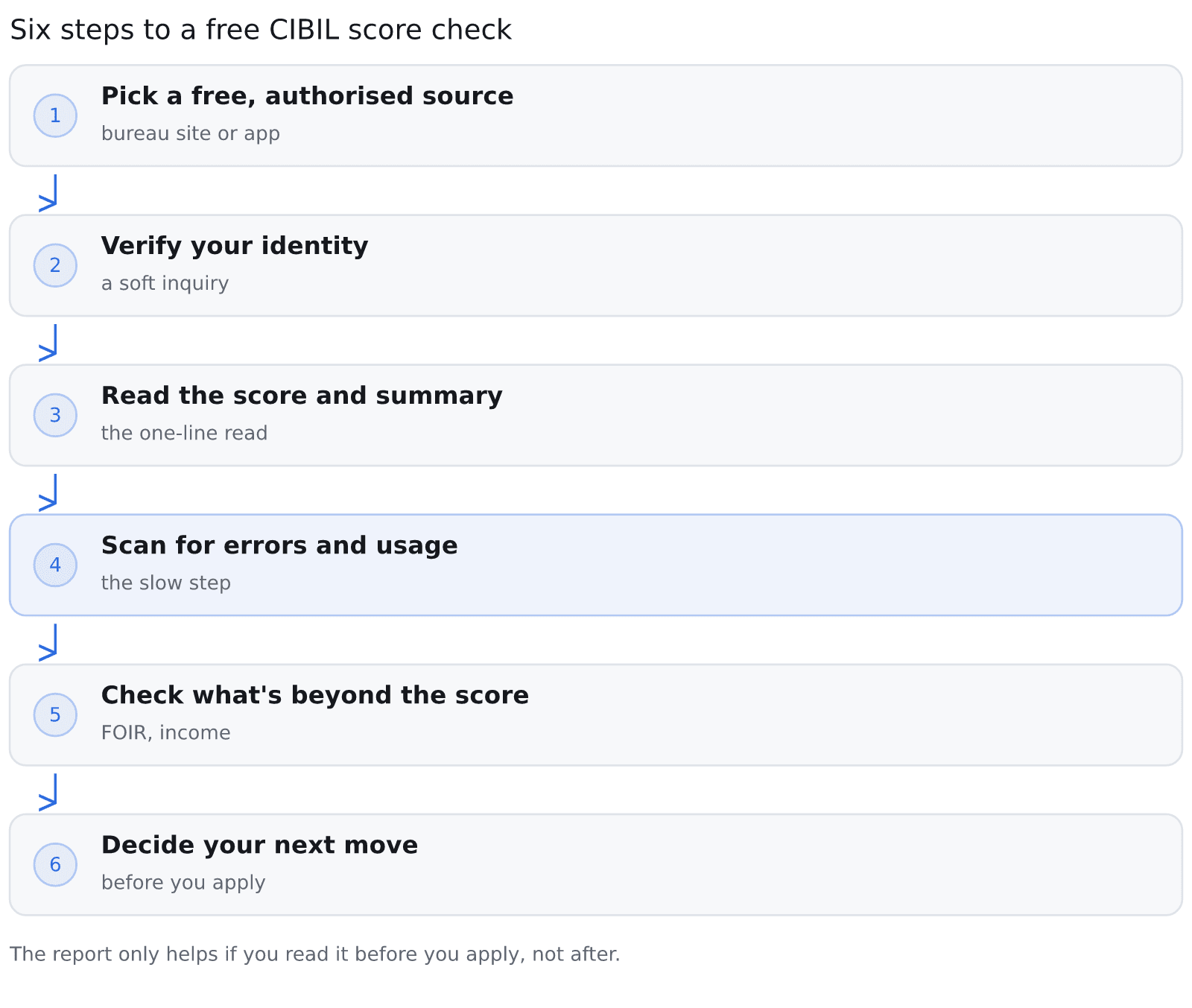
Checking your own score is what the industry calls a soft inquiry. CRIF High Mark's own explainer is direct about it: "this is considered a soft inquiry, which does not affect your credit rating." A hard inquiry is a different thing entirely: it happens when a lender pulls your report because you've applied for credit, and it shows up on your file in a way a self-check never does.
What it should look like when it worked: you land on a dashboard or a PDF with your name, not a generic sample. If the identity check fails twice, stop and call the bureau rather than retrying with guessed details.
The mistake people make here: confusing this soft check with a loan application and assuming it'll ding their score. It won't, and that's worth remembering the next time a form asks "may we check your credit?" before you've actually applied for anything.
Step 3: Read the score and the one-line summary first
Before you scroll to the account list, look at the number and whatever one-line read the bureau gives it (something like "fair," "good," or "excellent," worded slightly differently by each bureau). This tells you where you stand today, in the same terms a loan officer will see it.
A score on its own doesn't tell you why it's where it is. That's in the report below it: factors the bureau flags as helping or hurting, usually your payment history and how long you've had credit. Card usage counts too, and step 4 is where you check that one properly. Note which factors are flagged before you move on.
What it should look like when it worked: you can say, in one sentence, both your number and the one or two reasons the report gives for it.
The mistake people make here: stopping at the number. A good score next to three missed payments from two years ago, and the same good score with a spotless file, read the same to you. They don't read the same to every lender's policy. Read the sentence under the number, not just the number.
Step 4: Scan the report for the things that actually hurt you
This is the step worth the most time. Go through the account list and check three things against your own memory of your finances.
Errors. A loan you closed years ago still marked open. A card that isn't yours. A payment marked late that you're sure you made on time. These happen more often than people expect, because the report is only as accurate as what each lender sent in.
Missed or late payments. Even one, reported months ago, stays visible for a while. You can't erase a payment you genuinely missed, but you can make sure nothing more recent slips through while you're applying.
How much of your limit you're using. If your card balances sit close to your limit, carrying that into a home loan application doesn't help your case, even though a card limit and a home loan are entirely different products. Paying balances down before you apply, not after, is the useful order.
If you find a genuine error, you have a route, not a guess. Under RBI circular RBI/2023-24/72, dated 26 October 2023, the lender that reported the wrong information has 21 calendar days to correct it once you've flagged it, and the bureau has 30 calendar days in total to resolve your complaint, or you're entitled to ₹100 for every day past that. Raise the dispute with the bureau directly through its website; it isn't a legal filing, just a correction request, so there's no need to involve a lawyer unless the lender refuses to act on a resolved dispute.
What it should look like when it worked: a short, specific list, maybe empty, of accounts, dates or balances you can point to and say "that's wrong" or "that's close to its limit."
The mistake people make here: finding one error and assuming the rest of the report is suspect too, or finding none and skipping the balance check entirely. Run both checks. They catch different problems.
What a self-check looks like next to a lender's check
| Soft inquiry (your own check) | Hard inquiry (a lender's check) | |
|---|---|---|
| Who triggers it | You, checking your own file | A lender, once you apply |
| Shows on your report as | Not visible the way a hard inquiry is | Listed as an enquiry |
| Affects your score | No | Can, temporarily |
| When it happens | Any time, as often as you like | Each time you submit an application |
Source: CRIF High Mark
Step 5: Check what a lender looks at beyond the score
A clean report gets you in the door. It isn't the whole conversation. A lender also works out your Fixed Obligation to Income Ratio, FOIR for short: your existing EMIs and other fixed outgoings, plus the EMI you're asking for, measured against what you actually take home.
Say, just to see the shape of the maths, your take-home pay is ₹50,000 a month and your current obligations plus the new EMI add up to ₹10,000. That's a ratio of 1:5. A lower ratio generally reads as more room to repay; a higher one reads as less, whatever your score says. Treat this only as an illustration of how the ratio works, not a number any real lender will quote you, because every lender sets its own comfort level and nobody but them can tell you what yours is.
Income stability matters too: how long you've been with your current employer, whether your income is salaried or self-employed, and how consistent it's been on paper. A borrower with a strong score and a messy income trail can still get turned down. A borrower with an average score but years of steady, documented income can still get approved. The score opens the file. These numbers decide what's in it.
What it should look like when it worked: you can say your rough FOIR and your income situation in one sentence each, the same way you learned to say your score and its reasons in step 3.
The mistake people make here: assuming a strong score cancels out a high FOIR. A lender weighs both into the same decision, not one after the other.
Step 6: Decide your next move before you apply anywhere
You now have three things: your score, a cleaned-up report, and a rough sense of your FOIR. Before you walk into a branch or fill out five different bank forms, each one a fresh hard inquiry, it's worth seeing what your profile is actually likely to get.
This is the gap an eligibility check is built for. You enter your numbers once, nothing gets sent to a bureau as an application, and you see where you plausibly stand against more than one lender's criteria before any of them has looked at your file. It won't tell you your exact rate or guarantee an approval; only a lender can do that once they've underwritten your file. What it does is let you compare before you commit to a hard inquiry with any one bank.
What it should look like when it worked: a shortlist of what you're likely to qualify for, in writing, before a single bank has pulled your file.
The mistake people make here: running a check like this once, then applying anyway to a bank it ruled out, just to "be sure." That's the hard inquiry you were trying to avoid, spent on a result you already had.
Common mistakes
- Checking only once, years apart. Your file changes every time you make or miss a payment. A score from a year or two ago tells you nothing about today.
- Applying to several banks to "see what sticks." Each application is a hard inquiry. A run of them close together reads, to an underwriter, like someone in financial trouble, not someone shopping around.
- Fixing the report after applying, not before. A dispute takes time to resolve. Start it weeks before you need the loan, not the week you submit your application.
- Ignoring FOIR because the score looks fine. A good score with a high FOIR can still mean a lower sanctioned amount, or a request for a co-applicant.
- Treating a free score site as equal to the bureau. Some aggregator sites show you a score, but the fine print on what they do with your data afterward is worth reading before you hand over a PAN number.
Frequently asked questions
Does a free CIBIL score check affect my credit score?
No. Checking your own score is a soft inquiry, and CRIF High Mark's own description of the difference is clear: a soft inquiry "does not affect your credit rating." It's a lender's hard inquiry, triggered when you actually apply for credit, that can have a temporary effect.
How often can I check my CIBIL score for free?
Under RBI circular RBI/2016-17/58 (1 September 2016), each bureau must give you one free full credit report, including your score, once every calendar year, from 1 January 2017 onward. You can use that free check with more than one bureau in the same year, since the rule applies to each Credit Information Company separately.
What if I find an error in my credit report?
Raise it with the bureau through its own dispute process. Under RBI circular RBI/2023-24/72 (26 October 2023), the lender that supplied the wrong information has 21 calendar days to correct it once notified, and the bureau has 30 calendar days in total to close the complaint, with compensation of ₹100 a day owed to you after that. It's a correction request, not a legal matter, unless a lender ignores a resolved dispute, in which case a lawyer is the right person to involve.
Is a good credit score enough to get a home loan approved?
Not on its own. Lenders also weigh your Fixed Obligation to Income Ratio and how stable your income looks on paper, among other things. A strong score helps, but the final call on whether you're approved, and on how much, belongs to the lender. Not to any score, and not to any platform that shows it to you.
What's the difference between checking my own score and using an eligibility check?
Both are soft checks that don't touch your score. A bureau's free score shows you your own file as it stands today. An eligibility check goes a step further and shows where that profile is likely to stand against more than one lender, in a couple of minutes, without a sign-up and without a hard inquiry on your file.


