

HDFC Home Loan Calculator: EMI, Fees and Limits
What the HDFC home loan calculator tells you
In short: An HDFC home loan calculator turns a loan amount, tenure and rate into a monthly EMI. HDFC's own example, ₹25 lakh for 20 years at 8.6%, gives an EMI of ₹21,854. It is an estimate, and HDFC sets your actual rate.
Most people open one the night before they talk to a bank. They type a round number, get an EMI, and then wonder what to do with it. That's normal. The EMI is only the first number, and the calculator can't see the things that decide whether HDFC says yes.
To run your own numbers, use Butter Money's EMI calculator. If you'd rather test what a different rate does to your own loan, Butter Money's overpayment page lets you enter your outstanding loan, EMI and rate to see what a lower rate would save you. Below: how the sum works, what HDFC itself publishes about rate, fees and tenure, one loan worked at three tenures, and where a calculator stops being useful.
How does an HDFC home loan calculator work?
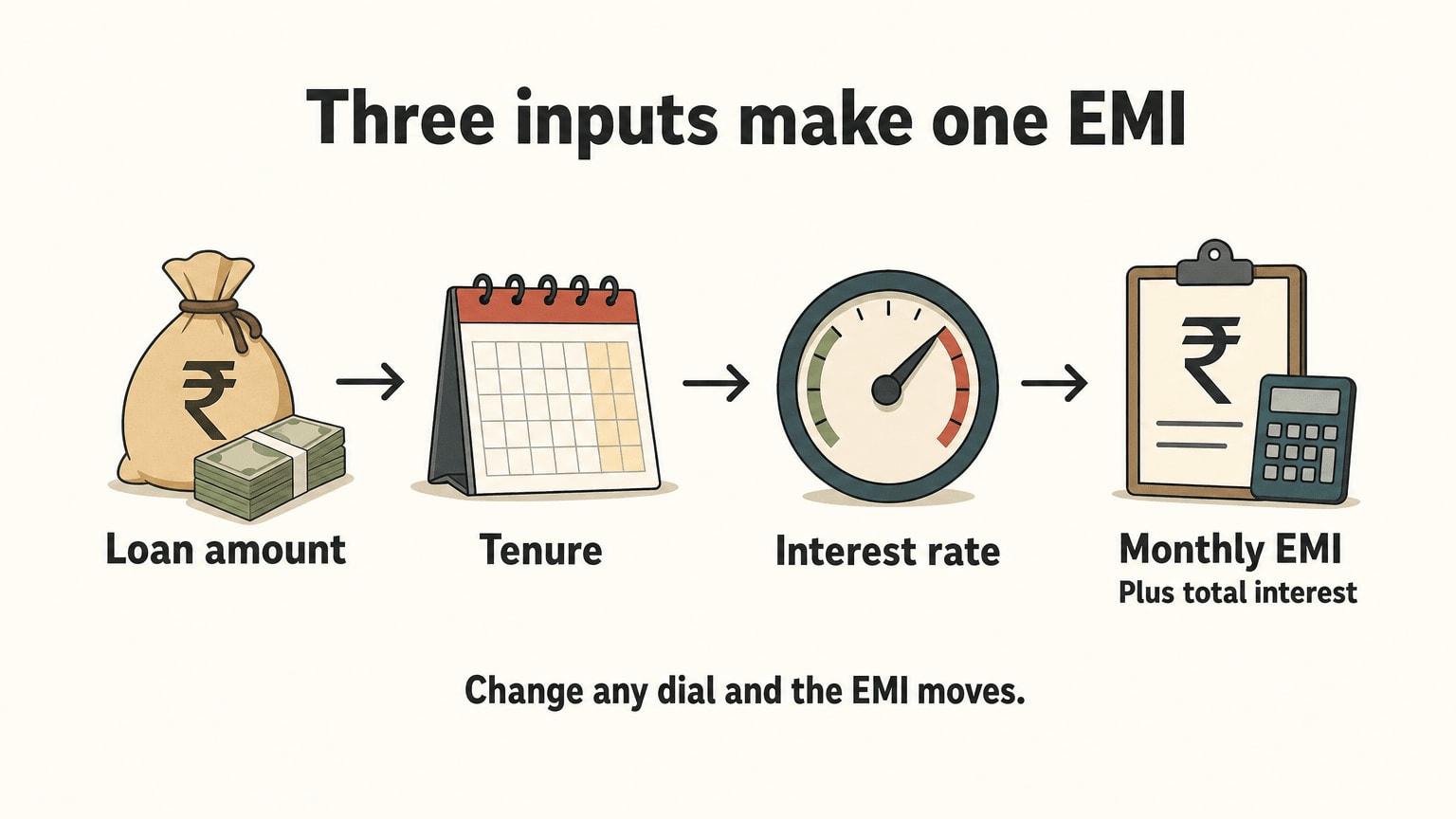
HDFC's own explainer calls a home loan calculator "the term loosely used for EMI calculator". Each EMI, it says, includes interest on the loan and part repayment of the principal. The page lists three inputs: loan amount, tenure and interest rate. Some calculators also show the total interest over the tenure.
The page doesn't print the formula. It's the standard one. With P as the loan, r as the monthly rate (the yearly rate divided by 12, as a decimal) and n as the number of months:
EMI = P × r × (1 + r)^n ÷ ((1 + r)^n − 1)
You never need to do this by hand. But knowing the shape explains the three dials. A longer tenure shrinks the EMI and swells the interest. A higher rate does the opposite. A bigger loan scales both.
I checked the formula against HDFC's own example before trusting it. Put ₹25 lakh, 8.6% and 20 years through it and you get ₹21,854 a month, the same figure HDFC shows. Total interest over the 20 years comes to ₹27,44,978, also HDFC's figure. So if a calculator you're using disagrees with that, something's off in the inputs.
What do you type in?
Three boxes, and each one hides a choice.
- Loan amount. This isn't the price of the flat. It's the price minus your down payment. HDFC caps how much it will fund, and that comes up below.
- Tenure. HDFC's page says up to 30 years, or until the age of retirement, whichever is lower. So the older you are, the shorter your longest tenure.
- Interest rate. The box that feels most official and is the least certain. More on that next.
One more habit worth having. Run the calculator three times, not once: at the rate you hope for, at a rate a little higher, and at one a lot higher. If the EMI still sits comfortably in your month in the third case, you have room. If only the first one works, the plan is tight, and it's better to learn that on a calculator than on a sanction letter.
What rate should you put in?
Here's where people get stuck, because the rates you see online don't agree. I read HDFC's home loan page on 14 October 2026. It says all its rates are benchmarked to the policy repo rate, and shows the range as the repo rate plus a spread of 2.50% to 7.95%, which it totals as 8% to 13.45%. A promotional box on the same page shows 8.50% p.a. "for credit score of 800 and above" and says "these rates are as on today". It carries no date.
I wouldn't treat 8.50% as the rate you'll get. It's the rate for one score band on an undated box. And I wouldn't trust a blog that quotes a single HDFC "starting rate" without a date, mine included. The page itself mixes figures from different periods, which is a good reason to read it directly and check the date on whatever table you find.
Why does the rate move at all? Since 1 October 2019, new floating rate retail loans have to be linked to an external benchmark. That's RBI circular RBI/2019-20/53, dated 4 September 2019, and it says the rate under the external benchmark shall be reset at least once in three months. So the EMI you calculate today is for today's benchmark. Butter Money's repo rate post explains how a repo change reaches your EMI or tenure, and how to find your reset date in the sanction letter.
HDFC alone decides the spread it offers you. That's the part a calculator can't guess.
A worked example: one loan, three tenures
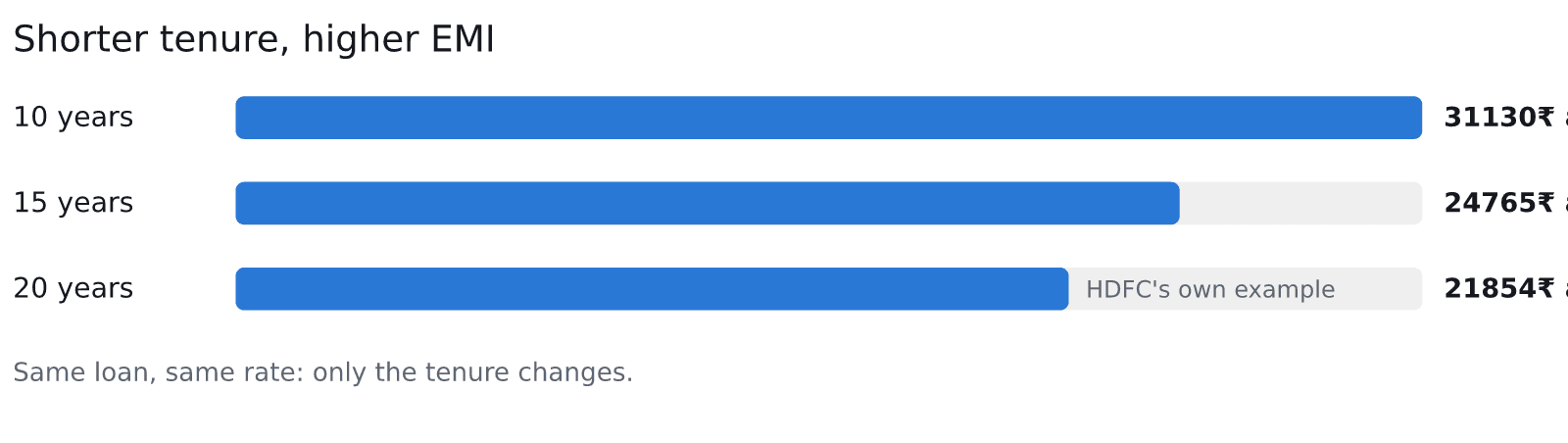
Take HDFC's own example loan: ₹25 lakh at 8.6%. Only the tenure changes. The 20-year row is HDFC's figure. The 10 and 15 year rows I worked out with the same formula, so they're close estimates.
EMI and interest for ₹25 lakh at 8.6%, by tenure
| Tenure | Monthly EMI | Interest over the loan |
|---|---|---|
| 10 years | About ₹31,130 | About ₹12.4 lakh |
| 15 years | About ₹24,765 | About ₹19.6 lakh |
| 20 years | ₹21,854 | ₹27,44,978 |
Source: HDFC's home loan calculator explainer for the 20-year row; the other two are my own working with the standard EMI formula.
Look at what the tenure does. Going from 20 years to 10 raises the EMI by about ₹9,300 a month. It also cuts the interest by more than half. Going the other way feels like relief, because the monthly number drops. It's also the quietest way to pay more, because every extra year is a year of interest.
If your month can take the shorter tenure, the total falls. If it can't, a longer one is a fair call, as long as you chose it. HDFC's page says there are no prepayment charges on floating rate home loans unless they were taken for business purposes. So you can start long and pay extra when a bonus lands. Fixed rate loans are different: the page lists a 2% charge plus taxes, except when you prepay from your own sources. Check which one yours is.
What does HDFC publish about fees, eligibility and loan size?
An EMI says nothing about what you pay to get the loan or how much HDFC will fund. These are the terms on HDFC's home loan page, read on 14 October 2026.
HDFC's published terms, in one place
| Item | What HDFC's page says |
|---|---|
| Processing fee, salaried and self-employed professionals | Up to 0.50% of the loan or ₹4,000, whichever is higher, plus taxes |
| Processing fee, self-employed non-professionals | Up to 1.50% of the loan or ₹5,000, whichever is higher, plus taxes |
| Maximum tenure | Up to 30 years, or till retirement age if sooner |
| Minimum income | ₹25,000 a month salaried, ₹3 lakh a year self-employed |
| Loan up to ₹30 lakh | Up to 90% of property cost |
| Loan from ₹30.01 lakh to ₹75 lakh | Up to 80% |
| Loan above ₹75 lakh | Up to 75% |
Source: HDFC Bank home loans page
A few notes on that table. The fee is non-refundable, per the page. The loan-to-value limits are, in HDFC's words, subject to the market value of the property and your repayment capacity as the bank assesses it. And the page says eligibility "is primarily dependent on income and repaying capacity".
Third-party pages quote different fee amounts for HDFC, and some list a credit score cut-off. I couldn't find a minimum score on HDFC's page, so I'm not giving you one. A figure that isn't on the bank's page with a date is a guess. Check the fee and the score rule with HDFC, in writing, before you plan around either.
Add valuation, legal and stamp duty on top and the cash you need up front is more than the down payment. Fees are real. A calculator doesn't show them.
What can't the calculator tell you?
Quite a lot, and none of it is your fault.
It doesn't know your salary, your other EMIs or your credit report. HDFC's own guidance on the explainer page is to keep loan repayments to a maximum of 30% to 40% of your monthly income. That's HDFC's rule of thumb, not a sanction rule, but it's a useful check. Divide the EMI by your monthly income. If the answer is above that range, a longer tenure or a smaller loan is worth a look.
It can't see the property. The valuation is the bank's. If it comes in below the price you agreed with the seller, the loan shrinks whatever the EMI said, and the loan-to-value limits above apply to the lower number.
It uses monthly steps. Banks can calculate interest differently, so the figure on your sanction letter may differ a little. Use the calculator to plan and the letter to commit.
And it can't tell you whether you'll be approved. Only HDFC can. Nobody else, including a calculator, a comparison page or a platform like Butter Money, controls that decision.

What should you do after you have the EMI?
Here's the order I'd use.
- Run three rates. The hoped-for one, a bit higher and a lot higher. Pick the EMI you could pay in a bad month, not a good one.
- Know your credit score before you apply. Each application is a hard enquiry. Two posts here cover it: the free CIBIL score check and how to improve your credit score.
- Read HDFC's page for the fee and the rate, with the date. Write down both.
- Try other tenures. Use Butter Money's EMI calculator if you want sliders.
- Compare before you commit. HDFC is one lender. Look at what another bank would ask for the same loan, rate, fees and tenure side by side.
- Read the sanction letter. Note the benchmark, the spread, the reset date and every fee.
The sanction, the valuation and the timeline belong to the lender. A calculator gets you to a sensible question. It doesn't get you the answer.
Frequently asked questions
Is the HDFC home loan EMI calculator accurate?
It's close, not exact. The formula is standard, and it reproduces HDFC's own ₹21,854 example for ₹25 lakh at 8.6% over 20 years. But the figure on your sanction letter depends on your actual rate and how the bank calculates interest. Use a calculator to plan, and the letter to commit.
What is the HDFC home loan interest rate?
HDFC's home loan page says its rates are benchmarked to the policy repo rate, plus a spread of 2.50% to 7.95%, which it totals as 8% to 13.45%. It also shows an undated 8.50% for a credit score of 800 and above. Your rate depends on your profile, and HDFC sets it.
What is the maximum tenure for an HDFC home loan?
Up to 30 years, or until retirement age, whichever is lower, per HDFC's page. So the older you are at the start, the shorter your longest tenure.
What is the HDFC home loan processing fee?
For salaried and self-employed professionals, HDFC's page says up to 0.50% of the loan or ₹4,000, whichever is higher, plus taxes. For self-employed non-professionals it's up to 1.50% or ₹5,000. The fee is non-refundable. Confirm the current amount with HDFC.
How much loan can HDFC give against the property value?
HDFC's page lists up to 90% of property cost for loans up to ₹30 lakh, 80% from ₹30.01 lakh to ₹75 lakh, and 75% above ₹75 lakh. All of it is subject to the bank's valuation and your repayment capacity.
Does using a home loan calculator affect my CIBIL score?
No. A calculator sends nothing to a credit bureau. Applying to a lender does add a hard enquiry. If you want to see what you could get first, Butter Money's eligibility check takes about 2 minutes and does not touch your credit score.
Can I prepay an HDFC home loan?
HDFC's page says you can prepay in part or in full. It lists no prepayment charges on floating rate home loans unless taken for business purposes. For fixed rate loans it lists 2% plus taxes, except when you prepay from your own sources.


