

SBI Home Loan Calculator: EMI, Rate and CIBIL Guide
What an SBI home loan calculator tells you
In short: An SBI home loan calculator turns a loan amount, rate and tenure into your monthly EMI. SBI's own page lists its home loan at 7.25%* p.a. onwards (from 01.04.2026). Your rate is SBI's call.
Most people open a calculator the night before a branch visit, type in a round number, and then wonder what to do with the answer. The EMI is only the first number. What decides whether SBI lends you that much is your salary, your existing EMIs and your credit history, and those come further down.
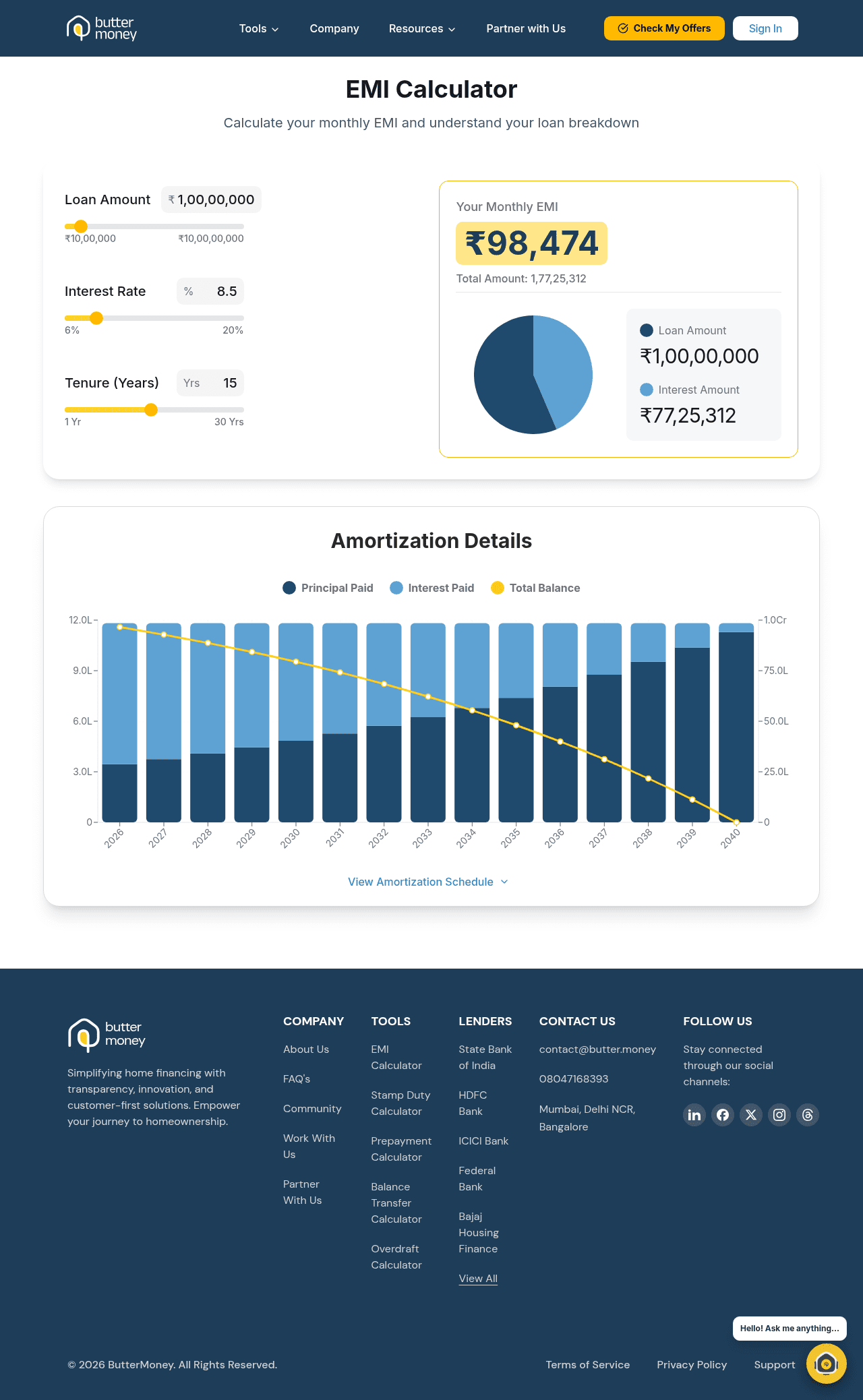
To try your own numbers, Butter Money's EMI calculator takes a loan amount, rate and tenure and shows the EMI and the total interest. Its sliders run from 1 to 30 years and from 6% to 20%, so you can test SBI's range and a few rougher ones too.
How does an SBI home loan calculator work?
It runs one formula. With P as the loan, r as the monthly rate (the yearly rate spread over the months of a year, as a decimal) and n as the number of months:
EMI = P × r × (1 + r)^n ÷ ((1 + r)^n − 1)
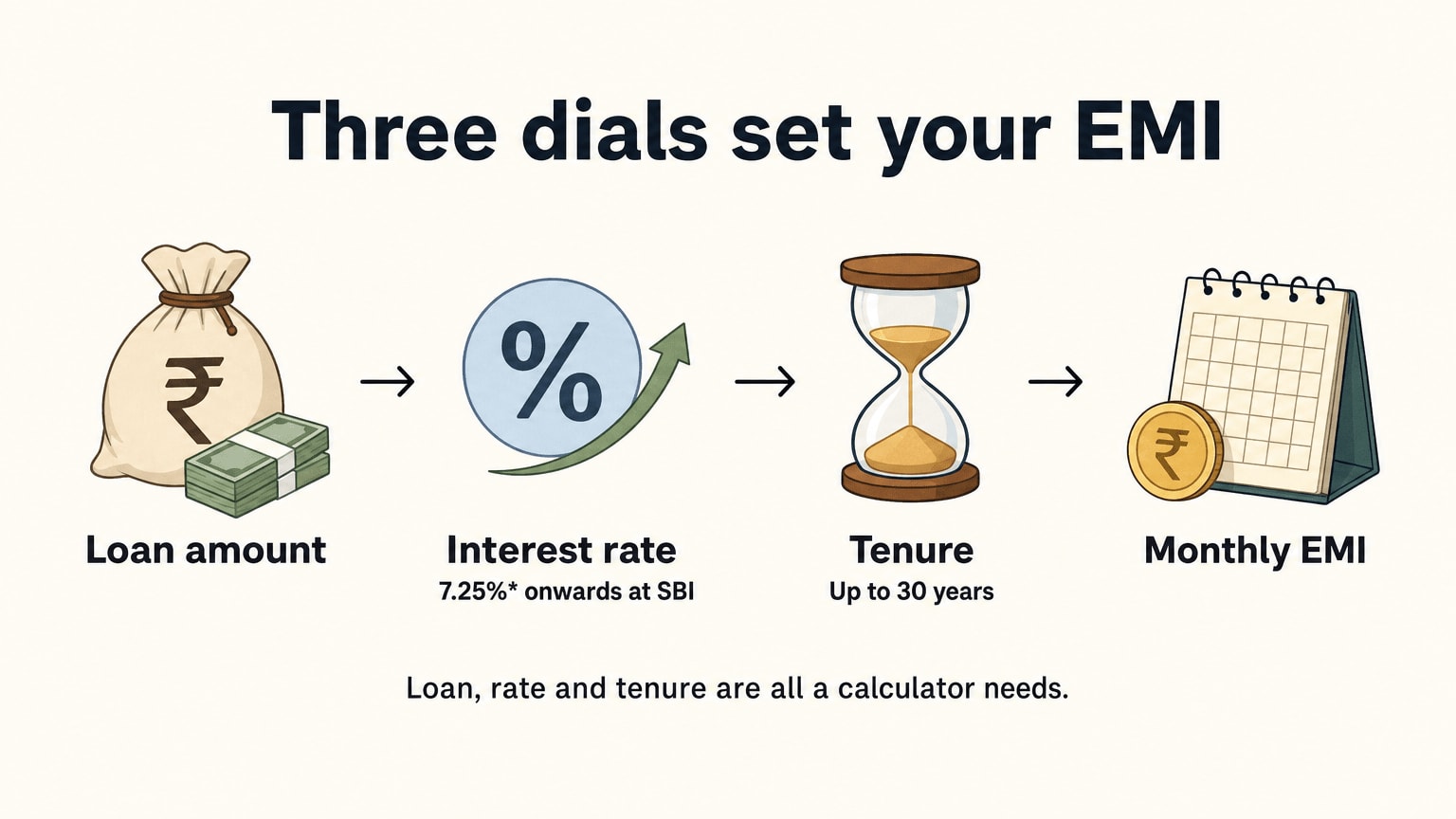
You don't need to do that sum by hand. But knowing the shape helps. A longer tenure shrinks the EMI and swells the interest. A higher rate does the opposite. Those are the only three dials.
One difference from real life. SBI says interest is charged on a daily reducing balance, so every EMI or prepayment cuts the outstanding principal at once. A calculator uses monthly steps, so treat its answer as a close estimate, not the figure on your sanction letter.
Here is what the Butter calculator shows at its default settings: a loan of ₹1,00,00,000 at 8.5% for 15 years gives an EMI of ₹98,474, and ₹77,25,312 of that total is interest. Those are default values on the page, not an offer from SBI or anyone else.
What a calculator can't tell you
It can't tell you whether SBI will say yes. It doesn't know your salary, your other EMIs or your credit report. It also can't see the property: the valuation is SBI's, and a valuation below the price you agreed with the seller shrinks the loan, whatever the EMI said.
And it can't tell you the rate. Whatever you type into that box is a guess until SBI sanctions the loan. So run it three ways: SBI's headline rate, a rate a bit higher, and a rate a lot higher. If the EMI is still comfortable in the third case, you have room. If only the first one works, the plan is too tight.
What is the SBI home loan interest rate?
SBI's loan rates page shows "7.25%* p.a. onwards", effective 01.04.2026. The asterisk is real. It means terms and conditions apply, and "onwards" means that is where the range starts, not what every borrower gets. Rates vary by lender and profile, and SBI sets yours.
Why does it move? Since 1 October 2019, banks have had to link new floating rate retail loans, housing included, to an external benchmark. That is RBI circular RBI/2019-20/53, dated 4 September 2019, and it says the rate under the external benchmark shall be reset at least once in three months. SBI's home loan site also says its rates are tied to the repo rate. So your EMI or your tenure can change at a reset. The repo rate post on this site explains which one and how to find your reset date.
What I couldn't confirm is the rate chart by credit score. SBI publishes it as an image, and I couldn't read it as text. I won't quote a slab I haven't seen. Open SBI's home loan site and read the chart there, with its date.
SBI's regular home loan page also lists an interest concession for women borrowers. The size of it sits in the same chart.
What does SBI need from you?
SBI's regular home loan page and FAQ give these basics.
- Who: resident Indians (the FAQ adds NRIs), aged 18 or over when the loan starts, with repayment finished by age 70.
- Tenure: up to 30 years.
- Loan size: it depends on an EMI to net monthly income ratio of 20% to 70%, by income slab. A co-applicant can raise it, and a spouse's salary can be added if the property is held jointly or the spouse is a guarantor.
- Processing fee: 0.35% of the loan plus GST, with a minimum of ₹2,000 + GST and a maximum of ₹10,000 + GST.
- Other costs: SBI also recovers out-of-pocket charges such as CERSAI, legal opinion and valuation fees.
- Prepayment: the page says there is no prepayment penalty.
The documents differ by how you earn.
What SBI lists, by type of applicant
| Salaried | Non-salaried | |
|---|---|---|
| Income proof | Salary slips for the last 3 months | IT returns and balance sheet with profit and loss account for the last 3 years |
| Tax papers | Form 16 for 2 years, or IT returns for 2 years | TDS certificate (Form 16A), if applicable |
| Bank statements | Last 6 months, all accounts | Last 6 months, all accounts |
| Extra | None listed | Business licence details, qualification certificate for professionals |
Source: SBI regular home loan page
Everyone also brings the application form with photos, ID and address proof, and the property papers. It isn't a no-paperwork loan. It is a pile you can gather in one weekend if you start early.
What CIBIL score do you need for an SBI home loan?
There's no single number I can give you, and I'd rather say so than guess. The SBI pages I could read set no minimum score. The FAQ doesn't mention CIBIL at all. The rate chart is where score would show up, and that is the image I couldn't read.
Here is what I can stand behind. CRIF High Mark puts scores on a 300 to 900 scale. It calls 750 and above excellent, 650 to 749 good, 550 to 649 fair and below 550 poor, and says a score above 700 is generally considered good. Each lender sets its own cut-offs. A higher score tends to help, but SBI alone decides what it offers.
So the useful move is to know your number before you apply. Pull the report free, fix anything wrong, and keep card balances low. Two posts here walk through it: the free CIBIL score check and how to improve your credit score. Each application adds a hard enquiry, so you don't want to learn your score from a rejection.
A worked salary example
Say your take-home pay is ₹1 lakh a month. Take it as an illustration, not SBI's rule. SBI's range for EMI against income is 20% to 70% by slab, and I don't know which slab you'd fall in.
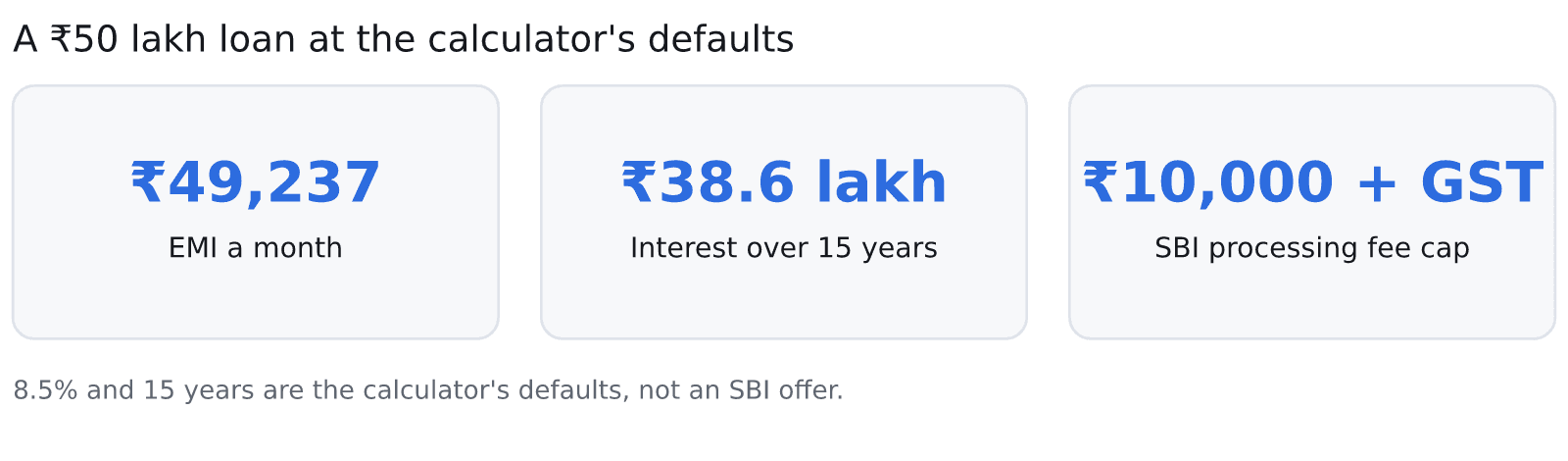
Suppose you're comfortable giving half of it, a ratio of 1:2, to the EMI. Also suppose you have no other EMIs. Using the calculator's default 8.5% and 15 years, a ₹1 crore loan costs ₹98,474 a month. EMI scales with the loan, so half the loan, ₹50 lakh, costs about ₹49,237 a month. That fits inside half your pay.
Interest scales the same way. On ₹50 lakh the interest comes to about ₹38.6 lakh over 15 years, from ₹77,25,312 on the default ₹1 crore.
Then add the upfront cost. 0.35% of ₹50 lakh is ₹17,500, but SBI caps the fee at ₹10,000 + GST. Valuation and legal charges come on top.
The example in numbers (8.5% and 15 years are the calculator's defaults)
| Default loan | Half of it | |
|---|---|---|
| Loan | ₹1,00,00,000 | ₹50 lakh |
| EMI | ₹98,474 | About ₹49,237 |
| Interest over 15 years | ₹77,25,312 | About ₹38.6 lakh |
Source: Butter Money's EMI calculator, halved by me
If you already pay a car EMI of, say, ₹10,000, the room for a home EMI shrinks by that much. That's how a good score with a heavy EMI load still gets a smaller loan.
A last thing to try in the calculator: keep the loan fixed and slide the tenure. A longer tenure makes the monthly number friendlier, and it feels like relief. It is also the quietest way to pay more, because every extra year is a year of interest. If your budget can take the shorter tenure, the total drops. If it can't, a longer one is a fair call, as long as you chose it. And since SBI says there is no prepayment penalty, you can start long and pay extra when a bonus lands. Check that against your own sanction letter.
Finally, one number alone shouldn't close the question. SBI is one lender. Before you commit, see what other banks would ask for the same loan, and compare the rate, the fees and the tenure side by side.
How do you apply to SBI?
- Run the numbers. Use the calculator for a few tenures. Pick the EMI you could pay in a bad month, not a good one.
- Check your report. Fix errors first, as the posts above explain.
- Gather the papers from the table above.
- Apply on SBI's online application link or at a branch. SBI's helpline is 1800 11 2018.
- Read the sanction letter. Note the benchmark, the spread, the reset date and every fee.
The valuation, the sanction amount and the timeline are all SBI's. Nobody else can promise them.

Frequently asked questions
Is the SBI home loan EMI calculator accurate?
It's close, not exact. The formula is standard, but SBI charges interest on a daily reducing balance, so the figure on your sanction letter can differ a little. Use a calculator to plan, and the letter to commit.
What is the SBI home loan interest rate?
SBI's loan rates page shows 7.25%* p.a. onwards, effective 01.04.2026, with terms and conditions applying. Your rate depends on your profile, and SBI decides it.
What is the maximum tenure for an SBI home loan?
Up to 30 years, but repayment must finish by age 70. So the older you are at the start, the shorter your longest tenure.
What is the SBI home loan processing fee?
0.35% of the loan plus GST, with a minimum of ₹2,000 + GST and a maximum of ₹10,000 + GST, per SBI's FAQ. Out-of-pocket costs such as legal opinion and valuation fees are extra.
Does checking my loan EMI affect my CIBIL score?
Using a calculator doesn't, because nothing is sent to a bureau. Applying to a lender does add a hard enquiry. If you want to see what you could get first, Butter Money's eligibility check takes about 2 minutes and does not touch your credit score.
Can I get an SBI home loan if I'm self-employed?
SBI lists documents for non-salaried applicants, including 3 years of IT returns and a balance sheet. Whether you qualify, and at what amount, is SBI's decision.


