
SBI Home Loan CIBIL: What Score You Really Need
What CIBIL score does SBI want for a home loan?
In short: SBI's pages publish no minimum CIBIL score for a home loan. For SBI home loan CIBIL planning, aim for 750 or above, which CRIF High Mark calls excellent (that is the bureau's label, not an SBI cut-off). SBI alone decides your rate and amount.
Plenty of pages online say "SBI needs 700" or "SBI needs 750". I went looking for that number on SBI's own pages and could not find it. That doesn't mean the score doesn't matter. It means the number you want is not printed where you can read it, so the useful job is to work out what you can know, and what only the branch can tell you.
If you want to see what you could get before you apply anywhere, Butter Money's eligibility check takes about 2 minutes and does not touch your credit score. Below: what SBI says and doesn't say about your score, what the score does to your rate, what else decides the loan, and what to do if your number is lower than you hoped.
SBI home loan CIBIL: what the bank publishes and what it doesn't
I read three SBI pages on 13 October 2026: the home loan rate page, the regular home loan product page and the home loan FAQ. Here is what each one says about your credit score.
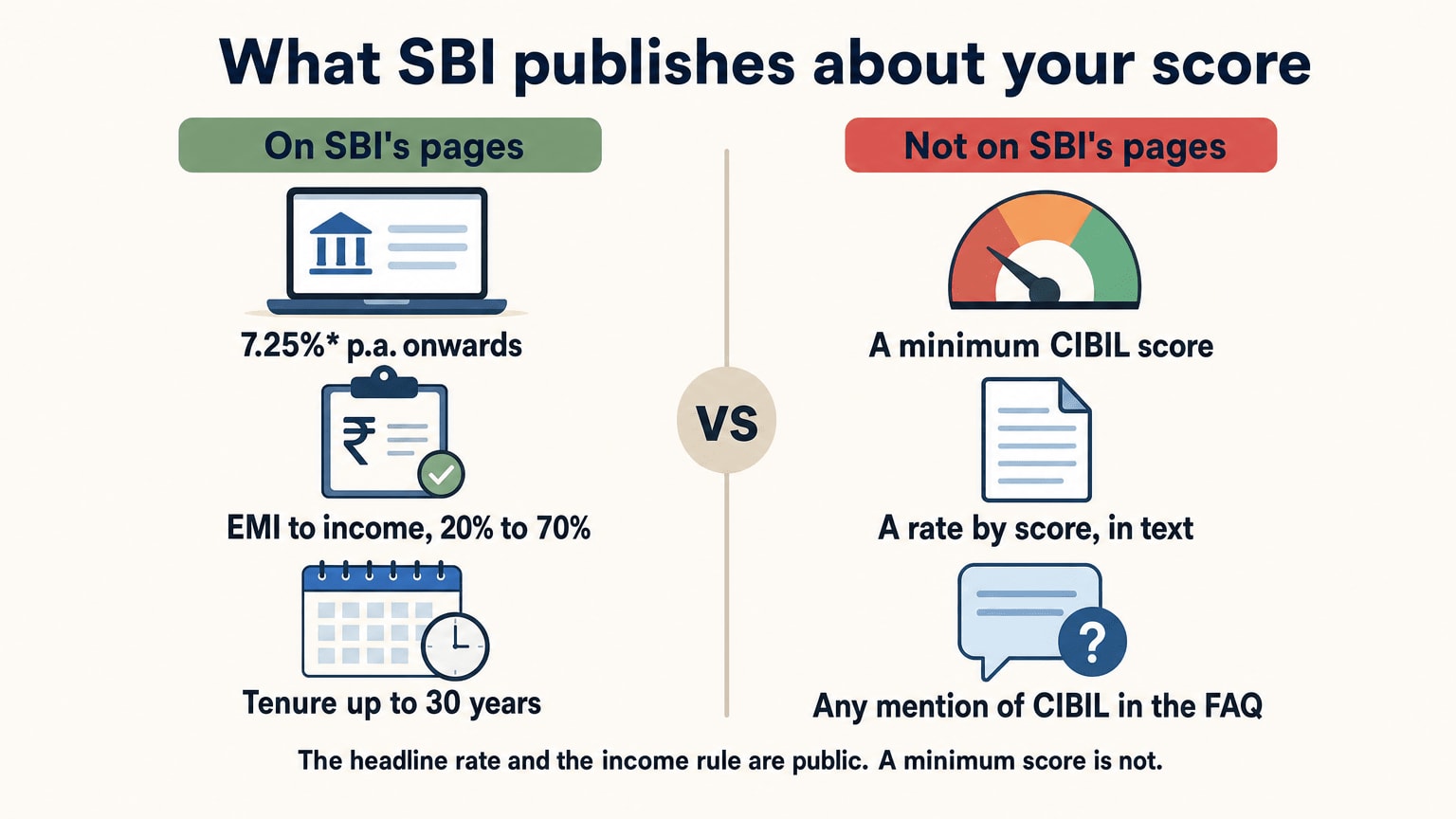
What SBI's own pages say about score, and what they leave out
| Question | What the SBI pages say |
|---|---|
| Is there a minimum CIBIL score? | None stated on the product page or the FAQ |
| Is the score mentioned at all? | The FAQ does not mention CIBIL or credit score |
| What is the rate? | 7.25%* p.a. onwards, with T&C apply, from 01.04.2026 |
| Does the rate depend on score? | The rate detail is a chart shown as an image, which I could not read as text |
| What sets your loan amount? | EMI to net monthly income, 20% to 70% by income slab |
| Is there a prepayment penalty? | The product page says no |
Source: SBI home loan rates, SBI home loans FAQ and SBI regular home loan
Read that table twice. The loud part is what's missing: nothing on the pages a borrower would normally read says "below X, we decline". The FAQ talks about age, repayment, income and the EMI to income ratio. It never says the word CIBIL.
Does that mean SBI doesn't look at your credit history? No. I'd be surprised if any bank lent a large sum without reading your credit report. It only means SBI hasn't published the rule, so a site that gives you a hard cut-off for SBI is saying something SBI's pages don't. I'd treat a precise number from a third party the way I'd treat a precise number from a friend of a friend.
Where this post differs from the SBI calculator post
Butter Money already has a post on the SBI home loan calculator, which covers the EMI maths, the fees and the documents. That post says it could not read SBI's rate chart. This one stays on the score: what it is, what it can and can't change, and how to get yours ready.
What counts as a good score, in numbers you can check?
A credit score runs from 300 to 900. CRIF High Mark's page is a bureau talking about its own score, and it gives these bands: 750 and above is excellent, 650 to 749 is good, 550 to 649 is fair, and anything below 550 is poor. The same page also says a score above 700 is generally considered good. So the bands overlap a little, and that's your first clue that nobody has a single "pass mark".
How one bureau labels the score bands
| Score | CRIF High Mark's label |
|---|---|
| 750 and above | Excellent |
| 650 to 749 | Good |
| 550 to 649 | Fair |
| Below 550 | Poor |
Source: CRIF High Mark
Two cautions. First, those are one bureau's labels. The score on your own report comes from whichever bureau you checked, and your lender may read a different one. Not every lender reports to every bureau, so your files can differ a little. Second, a label is not a lending rule. "Excellent" tells you how the bureau describes the number. It doesn't tell you what SBI will do with it.
What I'd take from the bands is simple. If you're at 750 or above, you're in the strongest group the bureau describes, and your score is less likely to be the weak spot in the file. If you're in the 650s or 700s, your file isn't a problem to hide, but it may be where a lender looks harder, and a few months of tidying could help. If you're below 650, plan for questions, and read the section on low scores further down.
Does your score change the rate SBI offers?
I can't confirm that from SBI's pages. I'd rather say so than paste a number I haven't seen.
SBI's rate page says "7.25%* p.a. onwards", effective 01.04.2026. The asterisk means terms and conditions apply. "Onwards" means that is where the range starts. It is not a promise that you get it. The page then points to a rate chart, and that chart is an image. I couldn't read it as text, and I couldn't confirm any slab by score from SBI itself.
I also looked at the score-by-score tables that comparison sites print. They don't agree with each other. They quote different benchmark rates and different slabs, and some are clearly from older years. A table that was right in one year is wrong the next, because the benchmark moves and SBI updates its chart. So I've left them all out. If a figure is not on SBI's page with a date, I won't give it to you as SBI's.
What you can do instead takes a few minutes.
- Open the chart on SBI's page and read the date printed on it. Make sure it's the latest one.
- Find your band on the chart, using your own score from a fresh report.
- Ask the branch or SBI's helpline which rate applies to your profile, and ask them to put it in writing with the benchmark, the spread and the reset date.
Why does the benchmark matter? Because the rate on a floating loan is a benchmark plus a spread, and the benchmark resets on a schedule written in your sanction letter. Butter Money's repo rate post explains how to read that letter. A small gap between two score bands can look tiny in a headline and still be real money over a long loan, because it's charged on a large balance for many years. Your own sums will show that better than a general table, and the calculator post shows you how to run them.
What else does SBI look at besides your score?
Your score gets you into the conversation. These decide what's in it.
Income against EMI. SBI's FAQ says loan eligibility rests on the EMI to net monthly income ratio, which "varies in the range of 20% to 70% for different Net Annual Income slabs." That is a wide range, and the FAQ doesn't tell you which slab you fall in. Net monthly income here means your take-home pay after taxes and payroll deductions.
Your existing EMIs. Lenders call the same idea FOIR, the fixed obligation to income ratio: what you already pay out each month, plus the new EMI, against what you take home. The free CIBIL score check post has the longer version. Here is the short one. Say a fifth of your take-home pay already goes to EMIs and card bills, a ratio of 1:5. You've used up that slice before the home loan EMI even starts. A great score doesn't give that slice back.
Age and tenure. SBI lists a minimum age of 18 at the start of the loan, repayment finished by age 70, and a tenure of up to 30 years. The older you are when you start, the shorter your longest tenure, and a shorter tenure means a higher EMI for the same loan.
A co-applicant. The FAQ says the loan amount can be increased by including a co-applicant, and that a spouse's salary can be counted if the property is jointly held or the spouse is a guarantor. A co-applicant's credit history comes into the file too, which is worth remembering. Think about that before you add someone.
The property. The valuation is SBI's. If it comes in below the price you agreed with the seller, the loan shrinks, whatever your score was.
Your documents. Salaried and non-salaried borrowers bring different papers. The SBI calculator post has the list SBI publishes.
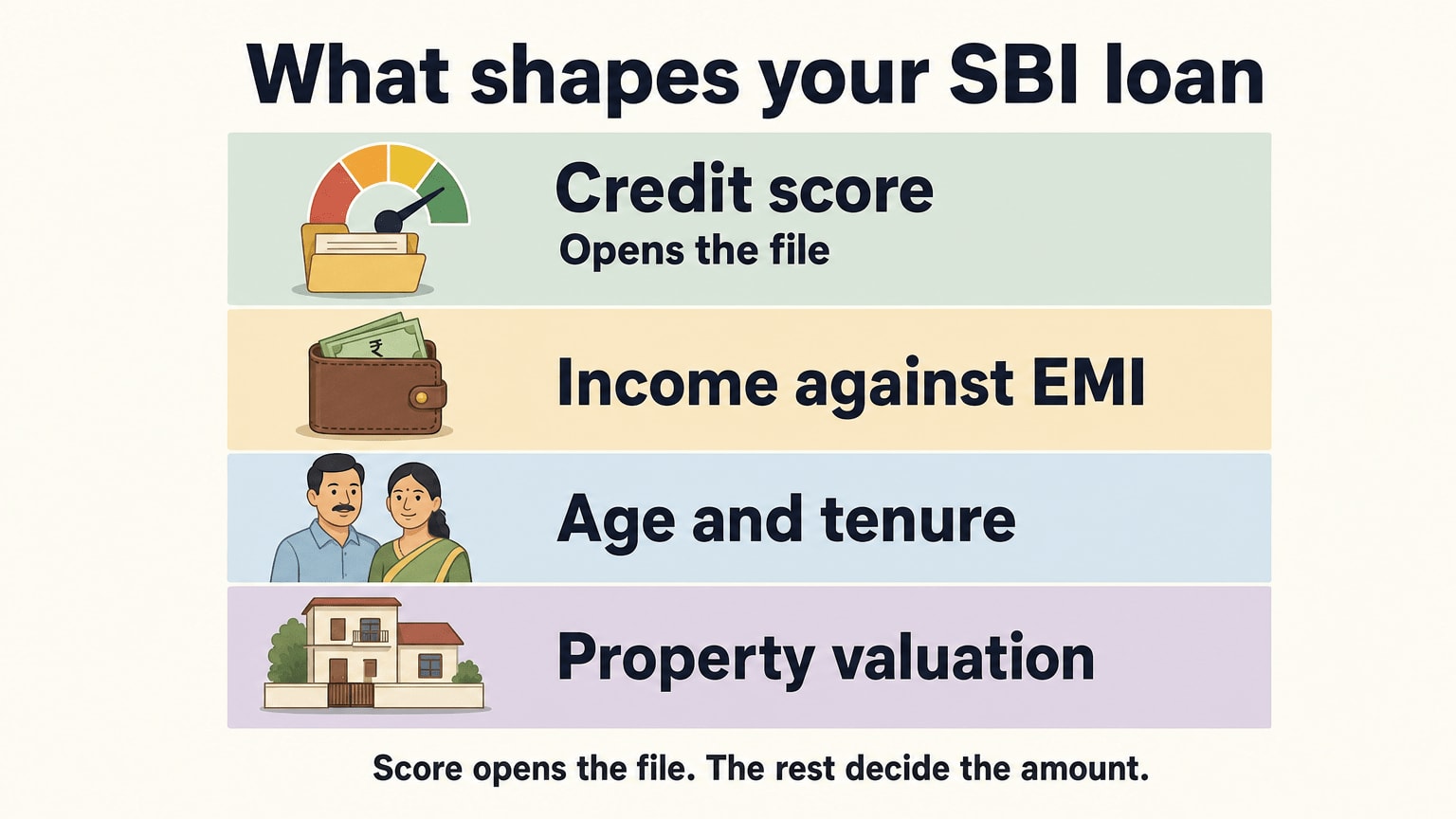
So here is a pattern worth knowing. Two people with the same score can walk away with very different loans, because one has a car EMI and a personal loan running and the other has none. And two people with the same income can see different rates because their scores differ. The score is one input. It is not the verdict.
Why a good score can still get a "no" or a smaller loan
This is the part nobody warns you about, and it's the most common reason a person with a clean file feels cheated.
A strong score tells a lender you've repaid on time. It doesn't tell them you can take on more. If your EMIs already eat a big slice of your pay, the lender may sanction less than you asked for, or ask for a co-applicant. If your income is hard to document, the file can stall even when the score is fine. If the property papers have a gap, the lender can hold things up whatever your history says.
None of this is you failing. It's how a lender splits one decision into several checks. When a loan comes back smaller than hoped, ask the bank which check moved it, and ask in writing. It's the only way to know whether to fix your credit file, your obligations or your paperwork. Fixing the wrong one wastes months.
What an application does to your score
Here's the catch with finding out your answer the hard way. When you apply to a lender, it pulls your report. That is a hard inquiry. CRIF High Mark's explainer says a hard inquiry may temporarily lower your score by a few points, and may stay on your report for up to two years. The same page adds that CRIF's own score isn't affected even by hard inquiries, so how much it costs you depends on the bureau and its model.
Checking your own score is a soft inquiry. CRIF High Mark says it "does not affect your credit score". That's the one you want to run first.
Two kinds of check, side by side
| Checking your own score | A lender checking after you apply | |
|---|---|---|
| Called | Soft inquiry | Hard inquiry |
| Effect on your score | None | May lower it by a few points, temporarily |
| How long it may stay on your report | Not recorded as a lender enquiry | Up to two years |
| When it's worth it | Always, before you apply | Once you've chosen where to apply |
Source: CRIF High Mark on hard and soft inquiries
The lesson is dull and useful. Don't learn your score from a rejection. Pull it free before you apply. Under RBI circular RBI/2016-17/58, dated 1 September 2016, each credit information company has to give you one free full credit report a year, score included, and that has applied since 1 January 2017. Butter Money's free CIBIL score check post walks through the steps.
What if your score is lower than you hoped?
First, breathe. A low score is rarely about being careless. A bill that went to a spam folder, an old loan a lender forgot to close, a card limit that was cut without a message: they all show up as a lower number. The report is only as accurate as what lenders send in, and lenders make mistakes.
So work in this order.
- Read the report, not just the number. Look for payments marked late, cards near their limit, accounts you closed that show as open, accounts you don't recognise, and a run of recent enquiries. Write each one down.
- Dispute what's wrong. This is the only step where a score can move without you changing how you behave. Raise it with the bureau and keep the reference number.
- Pay every EMI and card bill on time. CRIF High Mark says it plainly: "Late or missed payments lower your score." Nothing else on the list makes up for this one.
- Bring card balances down. Utilisation, how much of your limit you use, is one of the five factors CRIF High Mark lists, along with payment history, outstanding debt, length of credit history and recent enquiries.
- Stop applying for anything new. Every card or loan application adds a hard inquiry, and they pile up.
- Wait for the update, then check again.
Step 2 and step 6 are clocks, and they are the reason to start early. Here are the rules, with their dates.
- Under RBI circular RBI/2023-24/72, dated 26 October 2023, the lender that reported wrong information has 21 calendar days to correct it once told. The overall limit for resolving the complaint is 30 calendar days, and after that you're entitled to ₹100 per calendar day.
- Under RBI circular RBI/2024-25/60, dated 8 August 2024, credit information is updated fortnightly, as of the 15th and the last day of the month. The rule has applied since 1 January 2025. Lenders have 7 calendar days after each fortnight to send data and bureaus have 5 to take it in.
Add those up and a simple correction can take several weeks to show. Don't leave it for the week you want to apply.
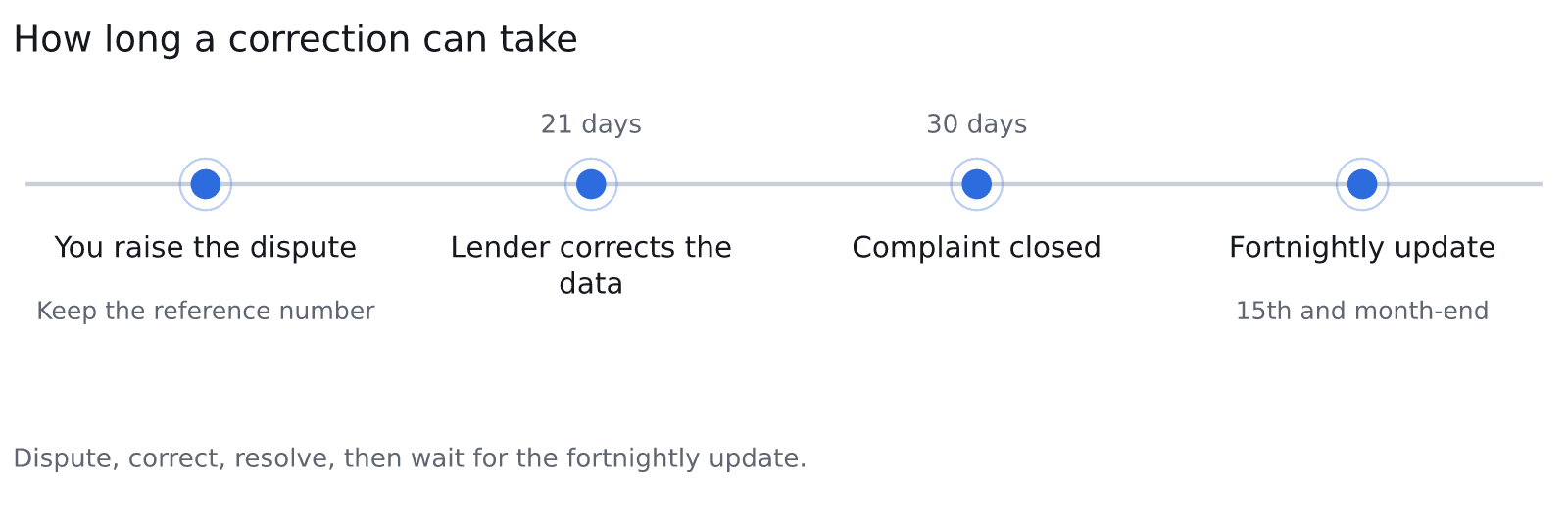
How the clocks stack up when you fix an error
| Stage | What the rule says |
|---|---|
| You raise the dispute | Keep the bureau's reference number |
| Lender corrects the data | 21 calendar days from being told |
| Whole complaint closed | 30 calendar days, then ₹100 per calendar day owed to you |
| Update reaches the bureau | Fortnightly cycle, as of the 15th and month-end |
Source: RBI/2023-24/72 and RBI/2024-25/60
Butter Money's post on how to improve your credit score goes through each step in more detail, including what not to do. One warning from it is worth repeating here. Don't pay a stranger to "repair" your score. A dispute is for entries that are wrong, and nobody can honestly promise to wipe out a payment you really did miss.
If you've already missed a payment
You can't undo the mark, but you can change what comes after it. Pay the overdue amount today. Make the next payment on time, and the one after. If an account is in collection or you're thinking of a settlement, ask the lender in writing what status they'll report once it's paid, because "paid in full" and "settled" read differently to a future lender. A recent clean run is the part of the report you can still shape. I couldn't find a bureau or regulator page that says how long a bad mark takes to fade, so I won't give you a number.
Should you wait, or apply with the score you have?
There's no formula, but there's a way to think about it. Ask three questions.
- Is something on the report wrong? If so, fix it first. It's cheap, and it can move the number for free.
- Are your card balances near their limits? If so, paying them down before you apply is the quickest honest change.
- Do you have a date you can't move? A sale agreement with a deadline is a good reason to apply sooner, with a co-applicant or a smaller loan if the numbers say so.
If your score is already in the strong band and your EMI load is light, waiting buys you very little. If the report has errors, or you've just missed payments, a few months buys a lot. The risk of waiting is that prices and rates move. The risk of applying early is a hard inquiry and a possible no. Only you know which is worse for your plan.
How to check before you apply
Here is the order I'd use, working back from the day you plan to apply.
- Pull your report from the bureau directly, a few weeks ahead. Don't type your PAN into the first site that promises a free score.
- Fix errors and start any dispute straight away, because of the clocks above.
- Note your obligations. List every EMI and card limit, and work out roughly what fraction of take-home pay already goes out each month.
- Read SBI's rate chart and its date. Find your band and write down the rate it shows.
- Run your own numbers. Try the loan at SBI's headline rate and at a rate a bit higher. If only the lowest rate works, the plan is too tight. The SBI calculator post shows how.
- See what other lenders would ask for the same loan, using a soft check, before you commit to a hard inquiry with any one bank.
- Apply once, to the lender you've chosen, and read the sanction letter for the benchmark, the spread, the reset date and every fee.
SBI's processing fee, per its FAQ, is 0.35% of the loan plus GST, with a minimum of ₹2,000 + GST and a maximum of ₹10,000 + GST, and out-of-pocket costs like CERSAI, legal opinion and valuation fees are recovered on top. The product page says there's no prepayment penalty. Check both against your own sanction letter.
The sanction, the valuation and the timeline are SBI's. No platform, Butter Money included, controls what a lender decides, and nobody can promise you an approval.

Common mistakes with SBI home loan CIBIL
- Quoting a cut-off you read somewhere. It may be someone's guess. SBI's own pages don't set one.
- Applying to find out. That's a hard inquiry spent on a question a free report would have answered.
- Looking only at the score. Your EMI load, your age, your tenure and the valuation all shape the loan.
- Fixing the report after applying. A dispute takes weeks. Start before you apply, not after.
- Using a slab table from an old page. The benchmark moves. Read SBI's chart and its date.
- Treating a smaller sanction as a verdict. Ask which check moved it, and ask in writing.
Frequently asked questions
What is the minimum CIBIL score for an SBI home loan?
SBI's home loan pages don't state one. I read the rate page, the product page and the FAQ, and none sets a minimum score. Pages that quote a cut-off aren't quoting SBI. A higher score tends to help, but SBI alone decides your rate and amount.
Is 750 a good CIBIL score for an SBI home loan?
CRIF High Mark calls 750 and above excellent, and 650 to 749 good. So 750 sits in the top band that bureau describes. That doesn't guarantee a particular rate or an approval, because SBI also weighs your income, your EMIs and the property.
Can I get an SBI home loan with a CIBIL score of 650?
It's possible, but I can't promise it, and neither can anyone but SBI. 650 is the bottom of the "good" band on CRIF High Mark's page. Expect the bank to look closely at your income, your existing EMIs and any late payments. Fixing errors and paying down card balances first can help.
Does SBI give a lower rate for a higher CIBIL score?
SBI's rate page shows "7.25%* p.a. onwards" from 01.04.2026, with terms and conditions applying, and the detailed chart is an image. I couldn't confirm slabs from SBI directly, so I won't quote any. Read the chart on SBI's page, check its date, and ask the branch which rate applies to you.
Does applying for an SBI home loan lower my CIBIL score?
When SBI checks your report after you apply, that's a hard inquiry. CRIF High Mark says it may lower your score by a few points, temporarily, and may stay on your report for up to two years. Checking your own score is a soft inquiry and doesn't affect it.
How long does it take to fix an error on my credit report?
Under RBI circular RBI/2023-24/72 of 26 October 2023, the lender has 21 calendar days to correct wrong data once told, and the complaint must be resolved within 30 calendar days. Then the fortnightly update cycle under RBI/2024-25/60 has to carry the change to the bureau. So allow several weeks.
Will SBI approve my loan if my score is good?
Not automatically. SBI also looks at your EMI to net monthly income ratio, which the FAQ puts in a range of 20% to 70% by income slab, plus your age, tenure and the property valuation. A good score helps your case. It doesn't decide it alone.
Can a co-applicant help if my score is low?
SBI's FAQ says a co-applicant can increase the loan amount. Their credit history is read too, so it can help or hurt. For anything about ownership or exits, a lawyer is the right person to ask.


